Written by: Briain Kelly, Editor
Air-to-Water heat pumps are the most common variety of heat pumps in Ireland due to their ability to meet heating and hot water needs, the ability to work with existing central heating systems, and simplicity of installation.
In this guide, we’ll explain how an air-to-water heat pump works, how much it will cost the average homeowner in Ireland, and what sort of benefits they can expect and the available grants.
What is an Air-to-Water Heat Pump?
An Air-to-Water heat pump uses the heat in the air outside of your home to heat water for the central heating system, and domestic hot water usage.
It differs from air-to-air systems in working with central heating rather than fan units. The heat source, outside air, also distinguishes it from ground or water source heat pumps.
Is an Air-to-Water Heat Pump Right for Your Home?
Best For…
- Home With Central Heating: Homes that already have a wet central heating system they rely on.
Home With Little Outdoor Space: Properties that don’t have the amount of outdoor space needed for a water source or ground source heat pump.
Retrofitting Projects: If you are upgrading your home with improved insulation, then it can be an ideal time for get a heat pump installed.
New Build Homes: An ideal heating system for new homes that can be designed to utilise a heat pump from the ground up.
Retrofitting Projects: If you are upgrading your home with improved insulation, then it can be an ideal time for get a heat pump installed.
Not Ideal For…
Badly Insulated Homes: Properties with a high level of heat loss might not benefit from a heat pump to the same degree as an airtight one.
Highly Priced Electricity: If you are on a plan with a high price per kWh of electricity that the heat pump will use.
How Does an Air-to-Water Heat Pump Work?
An air-to-water heat pump follows the same basic vapour compression principle as all other residential heat pumps. The only difference is in the requirements for the heat source, and how that heat is transferred and used in the home.
An external unit with a large fan blows air across the heat exchanger containing the refrigerant. This causes the refrigerant to vapourise and heat up.
The refrigerant is compressed to raise its temperature and pressure further.
This hot gas then goes through another heat exchanger. This is a unit through which water is pumped constantly. A metal coil containing the refrigerant also passes through the heat exchanger. This allows heat to be transferred to the hot water.
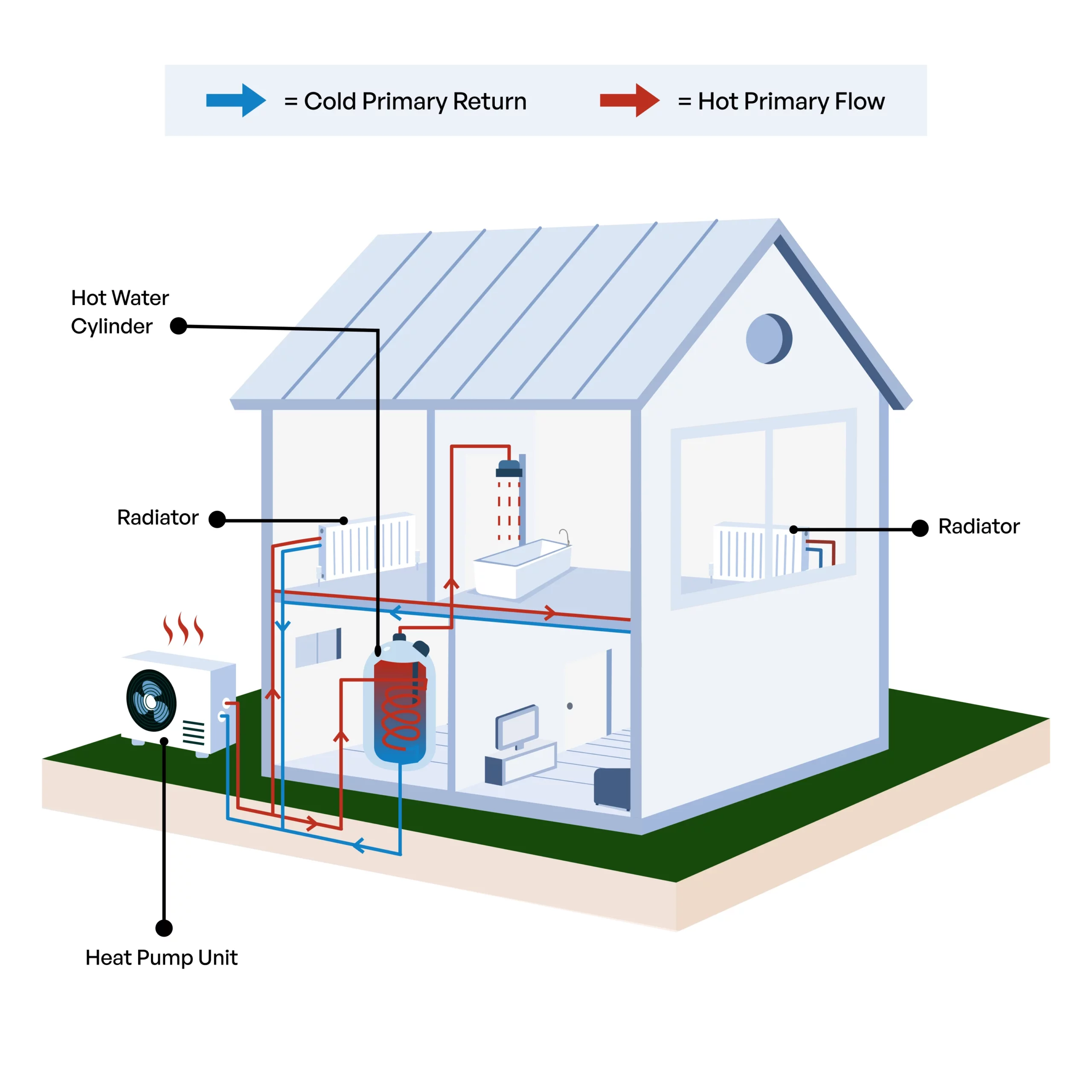
This hot water is then either passed through the central heating system, or stored in a hot water cylinder.
There are some differences in the setup of an air-to-water heat pump system depending on whether it is a monobloc or split system.
Types of Air-to-Water Heat Pumps
Air-to-Water heat pumps come in two distinct variations: a monobloc or split system. They differ in the number of units involved and how heat is transferred to your home.
A monobloc system heat pump consists of a single outdoor unit, while a split system heat pump has both an indoor and outdoor unit. These operate differently and have their own pros and cons.
Monobloc Systems
Where It’s Placed: A single outdoor unit contains both heat exchangers, with no indoor unit.
How it Works: Water is piped between your home and the outdoor unit, where it is heated by the system before returning.
Advantages: This takes up less space as there is no need for an indoor unit. This also tends to make them less expensive.
Disadvantages: More heat is lost by the water travelling to and from your home, making them less efficient.
Split Systems
Where It’s Placed: One unit with the evaporator and fan system is located outside. An indoor unit contains the condenser and hot water system.
How it Works: The refrigerant is cycled between the indoor and outdoor units. It gains heat from the outdoor unit and passes it to the water via the indoor unit.
Advantages: Allows the fan unit to be placed further away from the building. Has a greater efficiency with lower heat loss, especially in colder weather. More compact external unit.
Disadvantages: Takes up more space inside your home. It is also the more expensive option.
How Does a Heat Pump Heat Water?
The main use of a heat pump is for space heating, but they can also be used for domestic hot water. When it comes to making hot water, a heat pump works more like a system boiler than a combi boiler.
Heat pumps extract heat slowly from outside sources and typically operate at a lower temperature than boilers. This means they cannot heat water up as quickly, so an air-to-water heat pump will not be able to make hot water on demand.
The following factors are necessary for hot water production with a heat pump:
- 1
Hot Water Cylinder: A heat pump needs a hot water cylinder for storage if you want to make domestic hot water.
- 2
No Split Focus: Most heat pumps can’t provide space heating and hot water at the same time. For at least an hour, it must focus solely on filling or reheating the hot water cylinder.
Air-to-Water Heat Pump Pros and Cons
Benefits
Simple Installation
The larger the number of solar panels in the system, the higher the cost will be.
Hot Water & Heating
Unlike an air-to-air heat pump, they can meet both a home’s space heating and hot water needs. This eliminates the need for a separate hot water system.
Best Retrofit Option
This is the best and simplest way to retrofit a home’s existing central heating and hot water system with a heat pump.
Increased Home Comfort
By keeping your home at a set heat constantly, you will eliminate the uncomfortable peaks and troughs in temperature that can come with a boiler.
Drawbacks
Longer Water Heating Time
It will take longer for a heat pump to provide hot water for your home than a boiler due to the lower flow temperature.
More Complicated System
An air-to-water heat pump is more complicated to install than a boiler, and may require an assessment of your home’s suitability.
Significant Upfront Expense
Even with SEAI grants, a heat pump is significantly more expensive than a replacement boiler. There may also be additional costs if new radiators are needed.
Efficiency Varies with Temperature
A heat pump can become significantly less efficient in winter or at night when the temperature outside drops below 0℃.
Must Meet Planning Regulations
In order for a heat pump to be an exempted development, it must meet specific placement and noise requirements for the outdoor unit. Otherwise, planning permission may be required.
Air-to-Water Heat Pump Cost in Ireland
The average cost of an air-to-water heat pump system in Ireland is between €14,000 and €16,000 in Ireland. However, this is just the cost of fitting your home with a heat pump.
Before your home is ready it will need very good insulation. These standard can add to the cost or preparing your home for a heat pump.
SEAI grants can reduce the cost for eligible homeowners. If you receive all available grants, the median cost of a heat pump afterwards will be somewhere between €5,000 and €6,000.
Air-to-Water Heat Pump Grant
For Irish homeowners, up to €12,500 is available from the SEAI for heat pump systems. There are three strands to this grant programme.
Heat Pump Grant: €6,500 for any house type, or €4,500 for an apartment.
Heating System Upgrades: €2,000 for a house or €1,000 for an apartment
Renewable Heat Bonus: €4,000 if swapping to a heat pump from a fossil fuel boiler or other electric heating system.
This grant is available for any home built before 2021, as long as it has a sufficiently low Heat Loss Indicator. Learn more about how you can claim a Heat Pump Grant.
How much can you save with an air-to-water heat pump?
Installing a heat pump can easily reduce your annual energy bills for heating and hot water by at least 25%, saving hundreds of euro each year.
It is important to keep in mind that saving money on a heat pump relies on three factors:
- 1
An Energy Efficient Home: Your home must have very low heat loss, with good insulation, or else it will bleed heat. This will cause the heat pump to work harder and use more energy to compensate.
- 2
Low Electricity Prices: Heat pumps rely on electricity, which is more expensive per kWh than oil or gas. While a heat pump is more efficient than a boiler, it can work out more expensive if you pay a high price per unit of electricity.
- 3
Heat Pump Efficiency: The more efficient your heat pump is, the more heat it can produce from one unit of electricity. Setting your flow temperature lower can drastically improve the COP of a heat pump.
While we have assumed a year round Efficiency of 300% above, heat pumps can easily operate up to 400% efficiency (COP 4.0). Choosing the right electricity plan, with a good discount and time-of-use tariffs, can also be much cheaper per kWh.
Air-to-Water Heat Pump Installation


Making Your Home Heat Pump Ready
Before looking to get a heat pump, you need to make sure that your home is suitable for one. This may involve improving the insulation in your roof and walls. A BER Assessment will likely be the best way to determine which areas of your home need attention.

Get Quotes & System Design
Consult with multiple installers to get a range of quotes and a proper system design. It’s not as simple as just swapping out a boiler. The heat pump needs to be properly sized for your needs. Too large or too small, and its efficiency will be negatively affected.

Assessing Your Home
Your home needs to be assessed to determine multiple things. With a split system, you need to choose the right location for the outside unit. Your radiators, piping and hot water system will also need to be inspected to see if they are suitable.

Apply for a Grant
Once you have chosen an installer, you should apply to the SEAI for a heat pump grant. This requires details of the heat pump being installed, central heating improvements, and the estimated cost to get the appropriate grant level.


Install Your Heat Pump
It’s time to have your heat pump installed by your selected contractor, along with any other upgrade works to your heating system that need to be done at the same time.

Heat Pump Configuration and Handover
Your installer will show you how to utilise any software monitoring and control system which comes with your heat pump, and configure the settings for your heating and hot water needs. The system is now ready to be handed over.
FAQs
No, a heat pump cannot work in a power outage as it needs an electricity source to operate. The only exception to this rule would be if you have a battery storage system or off-grid solar panels.
Yes, an air-to-water heat pump is three to four times more efficient than a boiler. Oil or gas boilers have an efficiency of 92-94%, while electric boilers have a 100%. Heat pumps have an efficiency of 300% – 400%, depending on external conditions.
Some air-to-water heat pumps can operate in reverse, extracting heat from inside your home. However, they are far less effective at doing so than air-to-air systems.
Yes, air-to-water heat pumps can operate in conditions as low as -25℃. This is far lower than even the coldest winter in Ireland, where temperatures rarely go below -5℃
Yes, an air-to-water heat pump can work with underfloor heating systems, the same as it can with radiators.
Yes, an air-to-water heat pump can only heat water, but this is used in your central heating and domestic hot water systems. If you want something that can heat air directly or provide better cooling, then you need an air-to-air system.
You may need to replace your existing hot water cylinder if changing from a boiler to a heat pump. This is because the internal coil might be too small to generate enough heat with the lower flow temperature of a heat pump compared to a boiler.
Yes, a heat pump can be set up only to provide heating, and not hot water. This means you will need to use either electric immersion, or a hybrid system with a small boiler, to provide hot water.
The external unit needs to be placed somewhere with steady air flow and ease of access. This means there has to be enough of a gap between it and another surface to allow air to pass through it steadily. There also needs to be enough space for maintenance to be carried out on the heat pump.