

Published: February 3, 2026

Written by: Briain Kelly
Reading time: 7mins
Spray Foam Insulation – A Complete Guide
Spray Foam insulation has been the topic of a lot of discussion for several years now. There’s a lot of information flying around, making competing claims that it is the best thing on the market or that it will completely destroy your home.
In this guide, we will explain what spray foam insulation is, where and how it can be used, and its strengths and weaknesses.
What is Spray Foam Insulation?
Spray Foam insulation is the common name for liquid polyurethane insulation. This is a synthetic polymer which starts off as a liquid, but expands and hardens into a foam as it cures. This foam provides an insulating layer that is connected to the surface it is applied to.
Spray foam is known for being able to be applied quickly and simply over the target area. The liquid spray and expanding qualities of the foam also make it simple to insulate small areas and crevices.
Types of Spray Foam Insulation
There are two main types of foam insulation. Open cell and closed cell foams. These have different properties in terms of their thermal performance, how much they expand, and whether they are moisture permeable.
It is very important to use the right type of spray foam for your purposes. The wrong one could deliver a much worse performance than expected, or could even be damaging to your home.
Open Cell Spray Foam
Open cell spray foam is lighter and less dense than closed cell foam. It doesn’t block heat transfer as well as closed cell foam, but it has other advantages that make it preferable for home insulation.
Expands to Fill Spaces: Open cell foam expands to 100x times the original volume of the liquid as it cures. This allows it to reach into small spaces and awkward crevices inside a wall, or in an attic.
Moisture Permeable: Crucially, open cell foam allows moisture to pass through it. This is can be very important for home insulation if you wish to avoid
Low Density: Open cell foam has a low density and is lightweight. This is better for applying to buildings where you don’t want a weight dragging from it.
Sound Dampening: Open cell foam has acoustic insulation properties that can help to dampen sound in your home.
Closed Cell Spray Foam
Closed cell spray foam is one of the best thermal insulators available, with a very high R-value per centimetre and excellent protection against water ingress. However, some of the same properties that make it so good for commercial and industrial applications can render it less ideal for home insulation applications.
Thermal Performance: Closed cell foam’s density and many gas pockets make it far better at retaining heat or blocking heat transference.
Moisture Resistant: Closed cell foam is almost completely impermeable to moisture. This can make it good in situations where you don’t want any water getting through a barrier. However, it can be risky to use it if condensation is a concern.
Structural Support: The density and rigidity of closed cell foam mean that it can provide support to a structure, in a wall cavity, for instance. However, it should not be looked at as a replacement for repairing structural damage.
Benefits & Drawbacks of Spray Foam Insulation
Like all materials, spray foam insulation has its good and bad qualities. Whether it is the right choice for your home will depend on technical factors about your home and your budget. The quality of the installation work also plays a huge role. Many of the downsides listed below are based on bad installations or work that is poorly documented.
Benefits of Spray Foam Insulation
While foam insulation can take up to 24 hours to cure fully, the actual application can be done very quickly and simply. This reduces the labour costs of installation.
Spray Foam creates a fully airtight seal where it is applied. This gives it an excellent ability to reduce draughts in your floor or wall by filling any small gaps and cracks.
Spray foam insulation is one of the best available in its sheer thermal resistance. 100mm of spray foam has the same performance as approximately 170mm of mineral wool.
Drawbacks of Spray Foam Insulation
Banks and insurers have been very cautious about homes with spray foam insulation installed. This has largely been because of unregulated installers doing a poor job.
Unlike other insulations, spray foam essentially becomes a permanent part of the structure of the building where it is applied. This can make it difficult to inspect beams, rafters, and surfaces where it is installed for damage.
Spray foam, even the less expensive open cell type, is typically more expensive than other types of insulation.
Spray Foam Mortgageability
While spray foam insulation has been around for several decades, that is still relatively new for something that is meant to last the lifetime of a property. Badly installed spray can cause serious issues with the structure of a property, which may make financial lenders very nervous.
Older homes which had spray foam insulation installed poorly years and decades ago may have developed problems with ventilation and damp because these weren’t taken into account at the time. Timbers completely covered by insulation and inadequate ventilation can see those timbers rot over time.
This has mostly been an issue with the UK market, which adopted spray foam earlier than Ireland and is seeing the long term effects of cowboy work sooner. Many UK banks have refused to lend for homes with spray foam installed. This has not been an issue so much in the Irish market to date, but it is something to keep in mind if you are planning to sell in the future.
Insulating Your Home With Spray Foam
There are a number of areas in your home where spray foam insulation can be used, but it is not suitable for all surfaces.
Attic Insulation
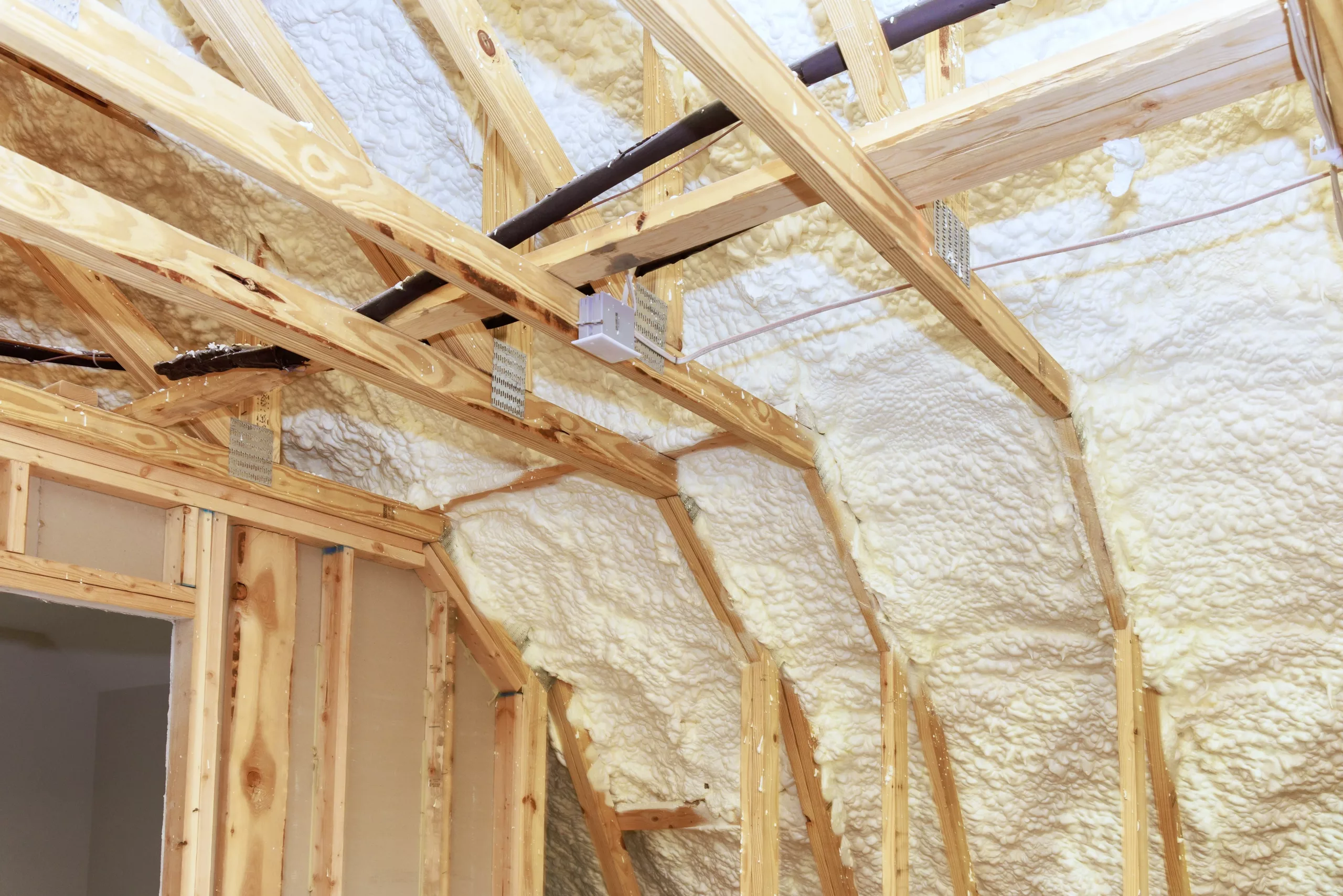
When insulating an attic, spray foam is used at the rafter level rather than between the loft joists. There are a number of reasons why spray foam is used for roof insulation.
Ease of Installation: Using spray foam insulation in attics makes it simpler for the installer to reach the full roof height and into small spaces. This can be done more quickly and simply than with solid insulation.
Less Complicated System: Spray foam insulation is sprayed directly onto the roof membrane and sticks to it as it hardens. This means that no additional methods are needed to secure the insulation and stop it from falling down.
The most important thing to be careful of if using spray foam for the attic is not to cover the rafters entirely. The foam should go between the rafters, but the inside edge must be left exposed if you want to avoid problems with damp and rot in the long run.
Cavity Wall Insulation
Spray foam is also becoming a more common choice for insulating cavity walls due to the simplicity of installation and the high thermal performance it delivers for a relatively small width.
Simple Installation Process: The foam is injected into the wall cavity from outside in its liquid state, using a process very similar to how bonded bead insulation is used for cavity walls.
Less Affected by Difficult Cavities: Because spray foam starts as a liquid and then expands to fill the cavity as it cures, it is less impacted by uneven cavity spaces of awkward wall ties than blown wool or polystrene beads would be.
Internal Wall Insulation
When using a stud wall for internal insulation, spray foam is one of the potential options to install between the vertical timbers in the partition frame.
Strong Thermal Performance: Stud walls are typically no more than 100mm thick. That is not a great depth when applying insulation. Spray Foam can deliver a better performance than mineral wool or solid boards at the same thickness.
Less Floor Space Lost: As a direct result of its good performance, less of your internal floor space will be lost using spray foam insulation than other materials.
Floor Insulation
When adding insulation to a suspended timber floor, spray foam is one of the potential choices if the insulation is being applied from below. A membrane is installed between the floor joists, and the polyurethane foam is applied directly to this.
Draught Proofs the Floor: By forming an airtight seal and expanding into cracks, spray foam insulation can also stop any draughts from coming through an old wooden floor.
Simple Installation Process: Insulating a floor from below can be an awkward process using solid insulation. There is little space to work in, and the insulation needs to be held in place to stop it from falling. Spray foam insulation does not have these difficulties.
As with rafter insulation, you must be careful not to completely cover the floor joists in order to avoid creating long-term damp problems.
Spray Foam Insulation Cost
The cost of spray foam insulation in Ireland can vary greatly for different projects, depending on a number of factors.
Insulation Type: Closed cell spray foam is typically more expensive than open cell foam insulation.
Area to be Covered: The larger the area that needs to be insulated, the higher the price of the project will be.
Insulation Depth: Spray foam insulation can be laid down in multiple layers to achieve a desired thickness. Cavity wall insulation, for instance, may be as small as 50mm in thickness, while rafter insulation would aim for 100mm.
Labour Costs: The price of labour for the work will vary depending on location and between different installers.
As an example, getting 100mm of spray foam insulation in an attic could cost in the region of €1,000 – €3,000 after getting an SEAI grant to help with the cost.
Are there grants for spray foam?
There are no specific grants aimed purely at spray foam insulation. However, the SEAI does have home insulation grants for different building elements such as:
- Attic Insulation
- Cavity Wall Insulation
- Internal Wall Insulation
- External Wall Insulation
- Floor Insulation
You can use spray foam insulation for different aspects of home insulation, but not all of them, as we addressed above. Read more about the value and eligibility criteria for Home Insulation Grants.
Tips for Spray Foam Installations
If you are getting spray foam insulation, make sure that the installer provides you with details of all the products they are planning to use.
Check with your home insurance provider to see if their policy allows the installation of spray foam insulation. This can avoid financial complications down the line if you want to sell the building.
Keep very clear records of what work is being done to your home and with what products. Take clear photos of the area where the insulation is being installed beforehand. If needs be, get a survey done of the condition of the roof or wall beforehand, the ventilation levels and requirements, and moisture checks.
FAQs
Yes, spray foam insulation can be removed from a property. However, it is difficult, time-consuming, and expensive as the foam attaches to the surface it is sprayed on.
Spray foam insulation could affect the value of your home in both good and bad ways. If it has been properly installed by a qualified installer, then the increased energy efficiency could raise its value. However, a bad job will lower its value as buyers may want it removed. A surveyor may want proof that the job was done right before assessing the value of your home.
The most common alternatives to spray foam insulation are mineral wool, natural fibres, or solid board insulation for attics, walls, and floors. Bonded polystyrene bead insulation is the most common material used for cavity walls.
Open cell spray foam, the kind most commonly used in home insulation, should last for 20-30 years. It may last up to 50 years, depending on the environmental conditions.
Yes, spray foam insulation is safe once it has finished curing. During the time when it is forming, it may give off dangerous fumes. Masks should be worn when it is being installed. In addition, you should not enter the space where it has been applied for 24 hours after the installation is complete.
No, you should not install spray foam insulation in a building with any kind of statutory protection. Spray foam attaches to the building and becomes part of it in a way that other materials don’t, even if it is removed.
No, you should not risk installing spray foam insulation yourself. The consequences of doing it wrong are much greater than with other insulations. Installers must also ensure that they have the proper protective equipment when doing this work.
It depends. Whether spray foam insulation is worth it for you will depend on whether you plan to keep or sell the property, what your budget is, and what your needs are. If you are improving your own home, which you plan to keep, then spray foam is far more worth it than if you want to sell in a few years.
Save over €500 a year on heating bills with home insulation
Get the best insulation upgrades for your home in just a few easy steps.
Author:
Briain Kelly
EDITOR
Briain Kelly is a Leinster based journalist and content creator who has been writing about energy efficiency and renewable energy technologies for several years now. He researches the latest news in multiple areas related to solar power, electric vehicles, heat pumps, and home energy upgrades. His writing includes both technological developments and government policy.
