Published: April 9, 2026

Written by: Briain Kelly
Reading time: 2mins
Home Solar Report 2026
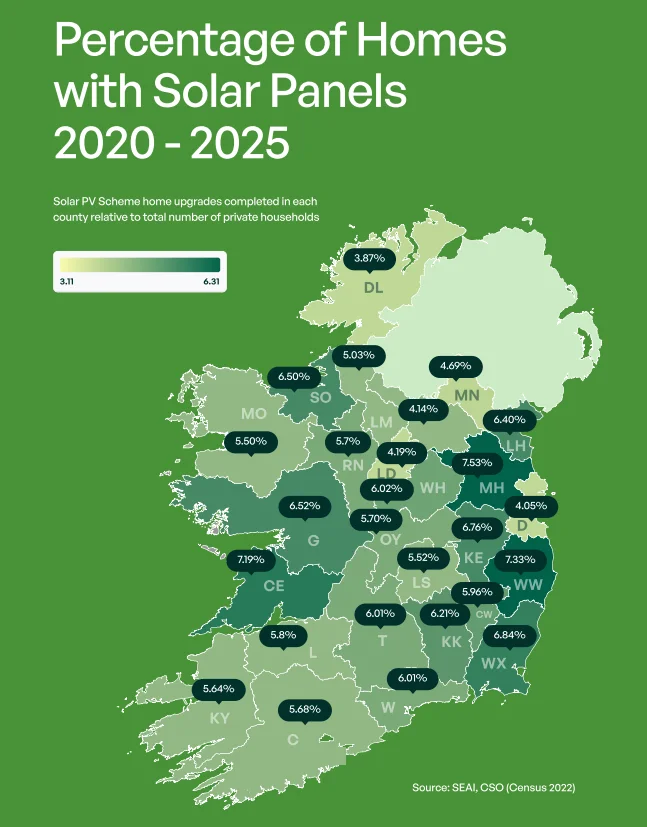
The residential solar sector in Ireland has exploded in size in the past five years, with more than 100,000 homes installing solar panels with the help of the SEAI grant scheme since 2020.
The ‘Home Solar PV Report 2026’ compiled by EnergyEfficiency has compiled data from SEAI’s Solar PV Scheme from 2020 to the end of 2025.
Using this data, we have examined how the number and price of solar panel installations have changed nationwide over five years. The report also shows where people are installing the most solar panels and what it costs them.
In that time, the number of solar panel installations has grown from 2,916 in 2020 to 33,042 last year. In the space of five years, the price of solar PV systems has also fallen dramatically, while average system sizes have increased.
To see a more detailed breakdown of domestic solar statistics in Ireland from 2020 – 2025, read the Home Solar PV Report 2026.
Home Solar Panels Now 39% Cheaper
The cost of solar panels has shrunk significantly in a short period, falling by more than €1,000 per kWp. In 2020, homeowners would pay an average of €2,762 per kWp for solar capacity. As of 2025, that had decreased to €1,689 per kWp.
The highest average cost per kWp in 2025 was in Dublin (€1,893), followed by Longford (€1,737), Wicklow (€1,730), Kildare (€1,738), and Meath (€1,725).
The counties with the lowest prices are Tipperary (€1,532), Kerry (€,1577), Sligo (€1,581), Offaly (€1,609), and Cavan (€1,623).
The average price tag for a solar PV system in 2025, before the SEAI grant is deducted, was €10,529. While this overall figure is not substantially lower than in 2020, people are getting far more for their money. Cost figures include the costs associated with battery storage in roughly half of all installations.
Solar Panel Systems Grow in Size as Prices Fall
The average size of solar PV systems has also increased by 68% in the time period covered in the report. In 2020, the average capacity of a residential solar PV system in Ireland was 3.7kWp. By the end of 2025, that had increased to 6.23kWp.
The counties which installed the largest systems in 2025 were Tipperary (6.83kWp), Kerry (6.79kWp), Roscommon (6.78kWp), Galway (6.77kWp), and Mayo (6.66kWp).
The smallest average system sizes are found in counties Dublin (5.32kWp), Kildare (6.14kWp), Meath (6.15kWp), Sligo (6.16kWp), and Leitrim (6.22kWp).
Many of the counties which are installing the most solar panels on average are also paying the lowest prices per kWp.
Falling prices for solar panels have made them more affordable than ever, while efficiency has gone up as more investment has poured into the sector.
The government has also made significant changes to regulations governing home solar to reduce the barriers to homeowners.
In 2022, planning exemptions were expanded to allow homeowners to install as many rooftop solar panels as they like without needing planning permission. The following year, VAT was eliminated on domestic solar PV installations.
Rising Energy Prices Make Solar a Lucrative Investment
At the same time that prices for solar panels have been declining, the cost of electricity has risen. The invasion of Ukraine in 2022 saw Irish electricity prices skyrocket, and they have remained high even after falling from peak levels in 2023.
These two factors combined have reduced the time it takes solar panels to pay for themselves in savings on electricity usage. Someone who bought solar panels for their home in 2020 would have been told that it would take them 10 years to pay off their cost. Today, that payback period has shrunk to no more than 6 years for most households.
Briain Kelly, Editor of EnergyEfficiency.ie said that while the number of solar installations continues to increase each year, the pace of growth has slowed. The government needs to ensure that the progress made in expanding the rooftop solar sector since 2020 is not allowed to slip away.
“While government action has helped propel the growth of domestic solar, there is still a huge well of untapped potential.”
“With more than 1 million homes suitable for solar panels in Ireland, more can be done to make people aware of how solar panels can reduce bills, while also propelling Ireland’s energy transition.”
Solar energy saves households thousands in electricity costs
Take our 2-minute questionnaire and find affordable solar options to suit your budget and lifestyle.