Written by: Briain Kelly, Editor
Poorly insulated homes cost their owners huge amounts of money every year in preventable heat losses. Up to 10% of a home’s heat can be lost through its floor, yet people rarely think about adding insulation there.
Whether you have a suspended timber floor or a concrete floor, it is important to have proper insulation to ensure that you create a tight seal around your home. Even if you insulate the rest of your house, this will just leave the floor as the only path of escape.
What is floor insulation?
Floor insulation consists of a layer of insulating material placed beneath your floor to prevent heat from escaping. This involves blocking heat from escaping directly into the ground or through the thermal bridge created at the junction between the floor and exterior walls.
Underfloor insulation is typically only needed at the ground floor level to prevent heat from escaping the envelope of the building. This can be between the floor and the ground, or between the floor and a basement if your home has one.
How Much Can You Save With Floor Insulation
A poorly insulated floor can result in a home losing as much as 10% of its heat into the ground. Compensating for this heat loss will push up your heating bills. Improving your home’s underfloor insulation will significantly reduce or eliminate this loss.
For a home that uses gas as its main space heating fuel, this could mean savings of up to €140 per year, depending on the property type.
*Gas usage figures based on CSO data ‘Household Gas Consumption by Building Energy Ratings 2023’
**Savings based on Gas price of 11.17c per kWh standard rate from Bord Gais (Inc VAT)
Cost of Floor Insulation in Ireland
The price of floor insulation will vary greatly between different homes. These costs can be divided broadly into two categories.
Materials Cost: The insulation materials can cost anywhere from €20 – €70 per square meter, as some insulation costs significantly more than others.
Labour Costs: Difficult to pin down, as they will differ between localities and contractors. The specifics of your home will also affect labour prices.
Grants for Underfloor Insulation Ireland
The SEAI does offer a €3,500 grant for floor insulation in Ireland. However, this grant is only available if you are going through the One Stop Shop service for multiple home upgrades.
You cannot apply for a floor insulation grant on its own through the Individual Energy Upgrades programme. This also means that the eligibility criteria for getting the floor insulation grant are different from those of other home insulation grants.
Read more in our guide to Home Insulation Grants.
Factors that Affect the Cost of Insulating Your Floors
Underfloor Heating: If you have an underfloor heating system, this will need to be taken up before insulation can go down. The underfloor heating will then need to be reinstated afterwards.
Floor Type: Whether you have a solid or suspended timber floor can significantly affect the amount of work involved in a project.
Insulation Material: Different types of insulation can have widely variable prices as detailed above.
Additional Labour: Some rooms will have far more work involved in preparing them for adding insulation. This can involve removing fixtures, dealing with wiring and more.
Property Size: If you are adding underfloor insulation to your entire home, then the cost will go up with the number of rooms to insulate.
Benefits of Floor Insulation
Adding insulation to your floor can reduce draughts coming up through the floor or under skirting boards, keeping your home warmer.
Floor insulation should save any home dozens of euro a year on energy bills at least. Particularly larger homes with more to heat.
Better insulation is the best way to raise the BER of your home, which will also increase its value as buyers seek energy efficiency.
Reduce the amount of heat being lost in your home by up to 10%. This gap can become even more important if the rest of your home is already insulated.
Types of Floor Insulation to Consider
Homes in Ireland can have many different types of floors, all of which will need to be addressed differently when it comes to insulation. The age of your home, its construction, and any issues that have cropped up since it was built must all be taken into account.
A suspended timber floor consists of floorboards laid on top of floor joists that penetrate into the external walls. They are more common in older buildings, and can be simpler to insulate between the floor joists.
Where are They Found: Suspended timber floors are more common in older homes built up to the 1950s.
How to Tell if You Have One: Look for airbricks around the exterior walls. You can also take up a floorboard to look for joists and an empty space beneath them.
How They are Insulated: This can be done with mineral wool or solid boards of insulation between the floor joists, or spray foam insulation applied to the underside of the floor.
A solid floor consists of a slab of concrete with the floor surface laid on top of it. Solid floors can be insulated either above or below the slab. Insulating above is simpler, but it will involve raising the floor level. Insulating below the concrete has less impact on your home, but is best done during major renovation works, as the floor slab needs to be removed.
Where are They Found: Concrete floors became common in Irish houses starting from the 1950s onwards.
How to Tell if You Have One: A solid concrete floor will not have airbricks around the lower outside of the floor, as there is no cavity space. The floor should also feel firmer than a timber floor, with no flex.
How They are Insulated: Solid floor insulation requires boards of solid PIR or a similar material. This is because of their ability to withstand compression without losing integrity.
Some much older homes may have stone slabs or tiles laid on top of compacted earth. These traditional floors need a cautious approach to avoid causing problems with damp in the long run.
Where are They Found: Very old homes that were built before suspended timber became the norm, or traditional homes built in poorer areas.
How to Tell if You Have One: Take up one of the floor tiles or slabs to see what surface is found beneath them. Before doing this, check if the building is protected as this can limit what you are allowed to do to it.
How They are Insulated: Similar to a concrete floor, but with much more care taken regarding moisture control. Very breathable insulation materials will be required.
The gap between your floor and the skirting boards on the wall can be a significant source of draughts, letting cold air into the room. This gap can also act as a thermal bridge at the wall/floor junction to allow heat to escape from a room.
A cheap and simple solution to this problem is to use draught excluding tape to fill the gap. These are long rolls of compressible foam tape which are sticky on one side.
- Buy Tape which is thicker than the gap between the skirting board and your floor.
- Use a flat tool to compress the tap and push it under the skirting board into the gap.
- The tape should expand to fill the width of the gap, while also remaining stuck to the floor.
Older vs Newer Housing Stock
Floor insulation is primarily a concern for homes which were built before the early 90s. When the building regulations were brought into effect in 1992, it became mandatory for homes to achieve some energy efficiency standards for the first time.
If your house was built after 1992, it most likely has a concrete floor with 25mm to 50mm of insulation below the slab already. While insulation has improved in quality since then, it is unlikely to be worth the cost of adding more insulation for small gains.
How Your Floor Type Affects Your Insulation Options
The type of floor you have will dictate both how it is insulated and the materials it uses. Both of these will ultimately factor into the price as well.
Suspended Timber Floors
Insulation Materials: Insulations such as mineral wool or natural wood fibre are preferred for their breathability. They also have the ability to compress somewhat. This is important for getting a good seal between uneven floor joists.
Installation Method: The most common method to insulate timber floors is to lift the floorboards and install insulation between the joists.
Solid Floors
Insulation Materials: Solid insulation boards such as PIR, XPS, and EPS are preferred for solid floor insulation as they have a high compressive strength. They also don’t require a great depth of insulation to achieve a good thermal performance.
Insulation Method: Solid floors are either insulated above or below the concrete slab. Insulating above is simpler, but it will raise the level of your floor. Insulating below the slab is a lot more work, but it leaves the floor level unchanged and turns the floor slab into a heat reservoir for your floor.
Factors to Consider When Getting Your Floor Insulated
Beyond just the materials and costs, there are several other factors that can affect your decision whether or not to get floor insulation. These relate to specific requirements under building regulations, as well as additional technical aspects beyond just the insulation itself.
Irish building regulations state that when renovating a building, you must achieve a certain U-value for that area. This is a requirement that you must achieve when adding insulation to a home.
When adding floor insulation, the building element must achieve a U-value of 0.45 W/m2K or lower in order to be compliant with these regulations.
Improving your home’s insulation can significantly improve its BER. During an inspection, a BER assessor will survey your property to determine its energy efficiency. This includes looking at the insulation you have installed.
However, you need to ensure that everything is properly documented for any home improvements to count in a BER Assessment. If you are installing floor insulation yourself, this will mean keeping receipts for all materials purchased and documenting every step of the process.
Without that proof, a BER assessor will use default values for building elements, which may have a worse U-value than what your home actually has.
Ventilation can be a very important concern for a home, depending on the type of floor that you have. While solid floors do not require ventilation, it is critical for suspended timber floors.
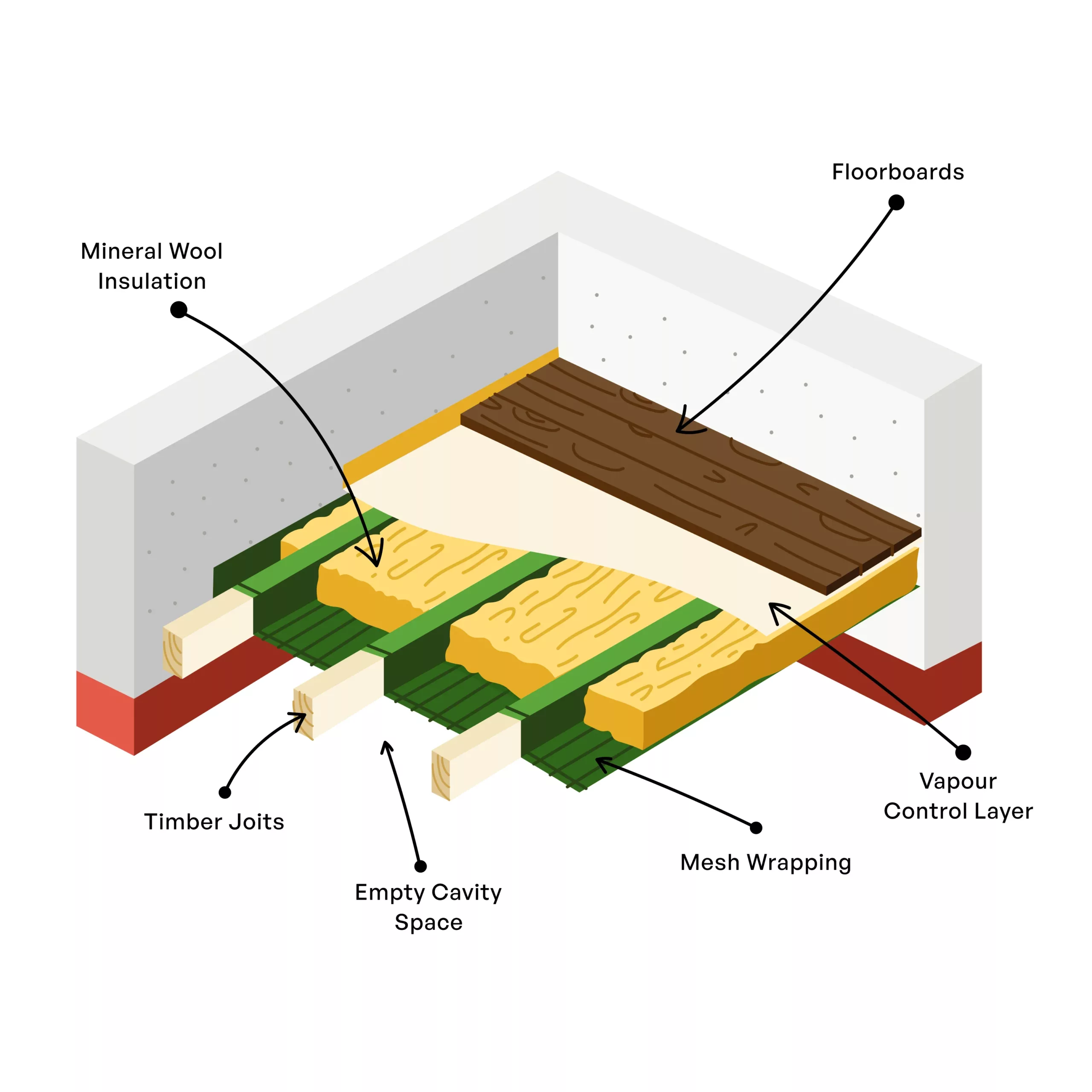
If you have a timber floor with floorboards over joists, then there will also be an empty cavity space below the floor. If you look at the outside of your home, you will notice airbricks or ventilation grilles close to the ground. They are there to keep a constant flow of fresh air through the underfloor cavity.
Without the flow of fresh air, your floor timbers will become susceptible to damp and rot. Over time, this can severely damage the floor. That is why it is essential not accidentally block up these vents when adding floor or wall insulation.
How to Install Floor Insulation
The installation process for installing floor insulation will depend on the type of floor you have. The process for putting underfloor insulation on a suspended timber frame is very different from doing so on a solid base.
Suspended Timber Floor Installation
Insulating From Above
- 1
Check the Floor Joists’ Condition: First, check the condition of the floor joists before installing any insulation. If the joists have any evidence of problems caused by damp or rot, they will need to be addressed first
- 2
Lift the Floorboards: Remove the floorboards, taking care not to damage them or any of the joists in the process. Keep note of where the boards are meant to go to make replacing them later simpler.
- 3
Place Netting: Put a netting mesh down to hold your insulation in place between the joists. When placing the netting, make sure that it creates a tight surface for the insulation to sit on between the joists. It also needs to run flush with the joists when going up and over each of them.
- 4
Install Insulation: Place your chosen insulation material between the joists, resting on the netting mesh. You will need to get a tight seal, as old timbers may be warped and no longer follow a perfectly straight line.
- 5
Add Vapour Control Layer: Install a vapour control layer on top of the insulation and joists to prevent any warm, moist air from getting into the insulation and joists.
- 6
Reinstate Floorboards: Once the underfloor insulation has been fully installed, you can replace the floorboards of the room.
Insulating From Below
If you have a basement or crawlspace large enough to work in below the floorboards, insulation can be applied from below. To do this, you must install an airtight vapour barrier to the underside of the floorboards between the joists before installing insulation.
- Fit your insulation snugly between the floor joists. This may need to be secured with netting or expanding foam.
OR
Apply open cell spray foam insulation to the underside of the floorboards. When doing this, make sure not to cover the underside of the joists, or this could cause interstitial condensation.
Solid Flood Insulation Installation
- 1
Remove Floor Surface: Remove whatever surface flooring you have, whether it is floorboards, tiles, or linoleum, in order to expose the concrete slab floor beneath.
- 2
Place Damp Proof Membrane: Lay down a damp-proof membrane either on top of, or below the concrete floor slab, depending on how you are approaching the project.
- 3
Place Insulation Boards: Place the solid insulation boards on top of the damp-proof membrane, making sure not to leave any gaps between the boards.
- 4
Add Vapour Control Layer: Install a vapour control layer on top of the insulation, on its warm side. This will stop warm, moist air from entering the insulation.
- 5
Cover Insulation with Flooring (Above the Slab): Cover your insulation with a layer of chipboard or concrete screed flooring material.
- 6
Lay Concrete Slab (Above the Slab): Lay down the concrete slab floor on top of the insulation layer
Floor Insulation FAQs
Adding a carpet might slow the loss of heat slightly by trapping air in its fibres, but it is no substitute for proper insulation for creating a warm seal.
It depends on the home. In a house, adding insulation beneath the ground floor is typically sufficient, as you are creating a heat envelope for the entire property. In an apartment building, it might be desirable to add insulation between floors, since each unit will be heated individually.
Homes may also benefit from acoustic insulation between floors to limit noise transmittance between levels.